Is Ledger Safe in 2026? The Breach, Ledger Recover and the Real Risks
An honest risk assessment of Ledger - what the 2020 data leak and the 2023 Connect Kit attack actually exposed, whether Ledger Recover changes the trust model, and where the genuine danger sits.
"Is Ledger safe?" is really three questions wearing a trench coat: is the hardware sound, is the company trustworthy, and is your usage safe. The answers are yes, mostly, and probably not - in that order of importance, reversed.
This is the sceptical version. If you want the product-by-product take, read the full Ledger review instead.
The short answer#
The device does its job. There is no publicly documented case of anyone's funds being stolen by breaking a Ledger's secure element. Every large Ledger-adjacent loss traces back to phishing, a malicious transaction the owner approved, or third-party software - not to the chip.
The company, meanwhile, has leaked customer home addresses, shipped a compromised JavaScript library, and launched a seed-backup service that contradicted years of its own marketing. None of those cost users their keys directly. All of them cost trust, and one of them made a lot of Ledger owners physically less safe.
Question 1 - is the hardware safe?#
Yes, to the standard that matters for individuals.
- The private key is generated inside a certified secure element (ST33 family; CC EAL5+ on the Nano line, EAL6+ on Flex and Stax) and cannot be exported by design.
- The PIN wipes the device after three wrong attempts, so a stolen device is a paperweight.
- BOLOS, Ledger's OS, isolates coin apps from each other so a flawed app for one chain cannot reach another chain's keys.
- Ledger Donjon, the in-house offensive security team, publishes attacks against Ledger's own products and competitors'. Very few wallet companies fund people to embarrass them in public.
The honest caveats:
- The firmware is closed source. The secure element vendor's NDA is the reason, and it is a real one, but it means no independent researcher can fully audit what runs on your device. You are trusting an audit process rather than verifying code.
- A physically-held device is a different threat model. Laboratory attacks on hardware wallets - fault injection, side channels - are a live research field for every vendor. A secure element raises the cost enormously; it does not make it infinite. If a state actor has your device and wants your keys badly enough, assume it is possible.
- Supply chain matters. A device tampered with before it reaches you is a real, if uncommon, attack. This is why you buy direct and run the genuine check.
Question 2 - is the company trustworthy?#
Here the record is mixed, and pretending otherwise would be useless.
The 2020 data breach#
An attacker accessed Ledger's e-commerce database in mid-2020. Around a million email addresses, and roughly 272,000 richer records including names, postal addresses and phone numbers, were taken and later published in full.
No wallet, key or coin was affected. What was affected was every customer's physical safety calculus: a public list of people who probably own crypto, with their home addresses on it. That list still circulates. Victims still get convincing phishing mail, fake replacement devices in the post, and occasionally threats.
Practical response: buy with a mail drop or a work address if you can, use a unique email alias per vendor, and treat any physical mail claiming to be from a wallet company as fake. There have been documented cases of counterfeit devices mailed to breach victims with instructions to enter a recovery phrase.
The 2023 Connect Kit supply-chain attack#
In December 2023, an attacker phished a former employee's npm credentials and pushed a malicious version of Ledger Connect Kit, a library that many third-party dApps load in the browser. For a few hours, visitors to unrelated websites were served wallet-drainer code. Roughly $600,000 was stolen before it was pulled.
The device was never compromised. But a security company left a publishing credential live after an employee departed, and the blast radius was everyone else's website. It is a strong argument for keeping your long-term cold wallet away from routine dApp browsing - use a separate hot wallet for the experimental stuff.
Ledger Recover#
In 2023, Ledger announced an opt-in, subscription service that can back up an encrypted, split copy of your seed with identity-verified custodians so you can recover with ID. The firmware capability shipped to devices generally, including those that never subscribed, and the reaction was furious - because the marketing had long implied the seed cannot leave the device, full stop.
The fair summary:
- It is opt-in. If you never subscribe, no shard of your seed goes anywhere.
- It requires explicit on-device consent plus identity verification.
- But it demonstrated that signed firmware can be built to export key material under some conditions. The security boundary was never "physically impossible"; it was always "Ledger will not sign firmware that does that."
Question 3 - is your usage safe?#
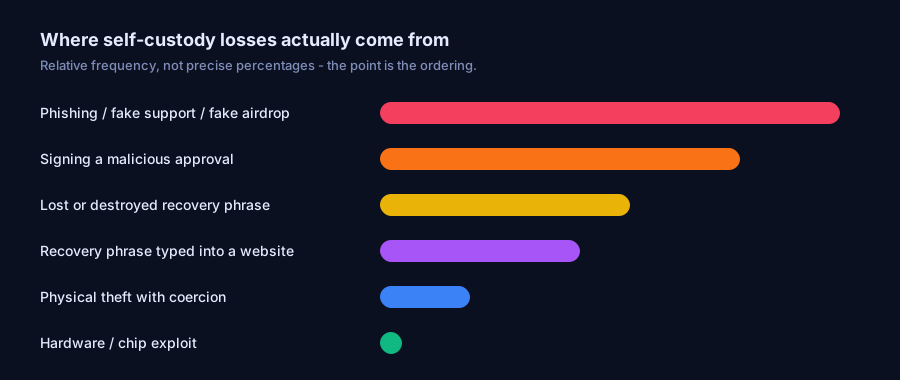
This is where the money actually goes. In rough order of frequency:
- You typed your 24 words somewhere. A fake support agent, a fake "Ledger Live update", a fake validator site, a fake airdrop checker. This single mistake accounts for more losses than every other cause combined. How these scams look.
- You blind-signed something. You approved a transaction whose contents your device could not display in readable form, and it granted a drainer unlimited spending on your tokens.
- You lost the backup. Fire, flood, house move, a card that faded. Not a hack - just gone. Backup properly.
- You did not verify the receive address on the device screen. Clipboard-swapping malware sent your deposit to someone else.
- You told people you own crypto. Physical coercion is rare but not hypothetical, and it starts with someone knowing.
Notice that a hardware wallet fully prevents only some of these. It is a strong lock on a door you can still open from the inside.
The realistic verdict#
| Risk | How likely | Does a Ledger help? |
|---|---|---|
| Malware steals keys off your laptop | Common | Yes - this is the whole point |
| Exchange failure or freeze | Occasional | Yes - you hold the asset |
| Phishing your recovery phrase | Very common | Only via the warnings; you can still be tricked |
| Signing a malicious contract | Common in DeFi | Partly - a bigger screen helps a lot |
| Losing your own backup | Common | No - that is on your process |
| Secure element broken remotely | No public cases | Yes |
| Vendor coerced or compromised | Unquantifiable | No - use multisig if this is your threat |
Ledger is safe enough that it is not the weak link in your setup - you are. That is not a dismissal; it is the correct way to allocate your attention. Buy the device, then spend your remaining paranoia on the backup and on what you approve, because that is where the losses come from.
How to make yours meaningfully safer#
- Buy direct, and run the genuine check before funding.
- Use an 8-digit PIN, not a birthday.
- Keep two backups in two buildings, ideally on steel.
- Add a passphrase only once you can store it as reliably as the words.
- Use a separate hot wallet for airdrops, mints and anything experimental. Your cold wallet should sign a handful of transactions a year.
- Revoke stale token approvals periodically with a reputable revoke tool.
- Never let anyone talk you into entering 24 words anywhere. There is no legitimate reason. Ever.
FAQ#
Has a Ledger wallet ever been hacked?#
Not the device itself, in any publicly documented case of user funds being stolen. Ledger the company has been breached - its 2020 customer database and its 2023 Connect Kit library - but neither incident exposed private keys held on devices.
Does Ledger Recover mean my seed is uploaded?#
Only if you subscribe. The service is opt-in, requires explicit on-device consent and identity verification, and does nothing if you ignore it. The valid criticism is not that it silently uploads keys - it does not - but that it proves signed firmware could be built to export key material at all.
Is my data at risk from the 2020 Ledger breach?#
If you bought before mid-2020, assume your name, email, and possibly your postal address and phone number are public. Nothing can undo that. Expect targeted phishing indefinitely, and be suspicious of any physical package or letter referencing your wallet.
Should I buy a Ledger after all these controversies?#
For the ordinary threat model - malware, phishing, exchange failure - yes. The alternatives with open firmware (Trezor Safe, Coldcard) are also good and worth considering if auditability matters to you. Leaving coins on an exchange because you distrust Ledger is trading a small risk for a larger one.
Is Ledger safer than a software wallet?#
Substantially, for anything you hold long term. A software wallet keeps your key on an internet-connected machine, where any malware that gets root gets the key. A hardware wallet moves that key behind a boundary malware cannot cross.
Disclosure. Some links on this site may be affiliate links. If you buy through them we may earn a commission at no extra cost to you. It never changes our verdict — we say when a product is a bad fit. Vaultwise is an independent publication. We are not affiliated with, endorsed by, or sponsored by Ledger SAS, Trezor/SatoshiLabs, or any wallet manufacturer. Product names and trademarks belong to their respective owners.
Keep reading
Ledger Scams and Phishing - Every Trick, and How to Spot It
The complete field guide to Ledger scams - fake support, fake Ledger Live updates, counterfeit devices in the post, drainer approvals and address-poisoning - with the tells that give each one away.
Targets: ledger scam email phishing
Ledger Hardware Wallet Review 2026 - Is It Still Worth Buying?
A full, independent review of the Ledger hardware wallet range - how the secure element actually protects you, what the 2020 breach and Ledger Recover really changed, and who should buy which model.
Targets: ledger hardware wallet review
Ledger Recovery Phrase - The Complete Guide to Your 24 Words
What the 24-word recovery phrase is, how to back it up so fire and burglary cannot take it, when the 25th-word passphrase helps, and exactly what to do if you think yours is compromised.
Targets: ledger recovery phrase
Get the self-custody checklist
One email a month: new scam patterns, firmware notes worth reading, and the mistakes that actually cost people money. No token shilling, ever.
Replace the form action with your own Formspree / ConvertKit / Buttondown endpoint in src/layout.mjs.